What Is a Jupe Table? How the Expanding Dining Table Works
How a jupe table opens from the center and stays round, where the 1835 design came from, how many it seats, and how it compares with round-to-oval tables.
Most extendable tables grow in one direction. Pull the ends apart, set a leaf in the middle, and a round becomes an oval or a rectangle gets longer. A jupe table works differently. The whole top opens outward from the center, a leaf settles into every gap, and the table ends up larger but still round. Anyone who sees one open wants to know how it works, and anyone who shops for one soon asks a harder question, which is whether a mechanism that clever is worth living with.
Any jupe table can be understood through two separate questions. The first is how many segments the top is cut into. Every jupe opens the same way, its segments sliding away from the center together, but the count decides how round the open table stays. The second is where the leaves live, in a fitted cabinet across the room as on the antique originals or folded beneath the top as on modern self-storing designs, and the answer decides how easy the table is to live with. Here is how each works, where the idea came from, how many a jupe seats, and what to check before you buy one.
What is a jupe table?
A jupe table is an expanding dining table whose top is divided into segments that slide outward from the center, with a leaf filling each gap, so the table grows larger and keeps its shape.
The name comes from Robert Jupe, the London upholsterer who patented the idea in 1835. His patent described a table "so constructed that the sections composing its surface may be caused to diverge from a common centre," with the spaces between them "filled up by inserting leaves or filling pieces." Nearly two centuries later, every jupe still works on that principle.
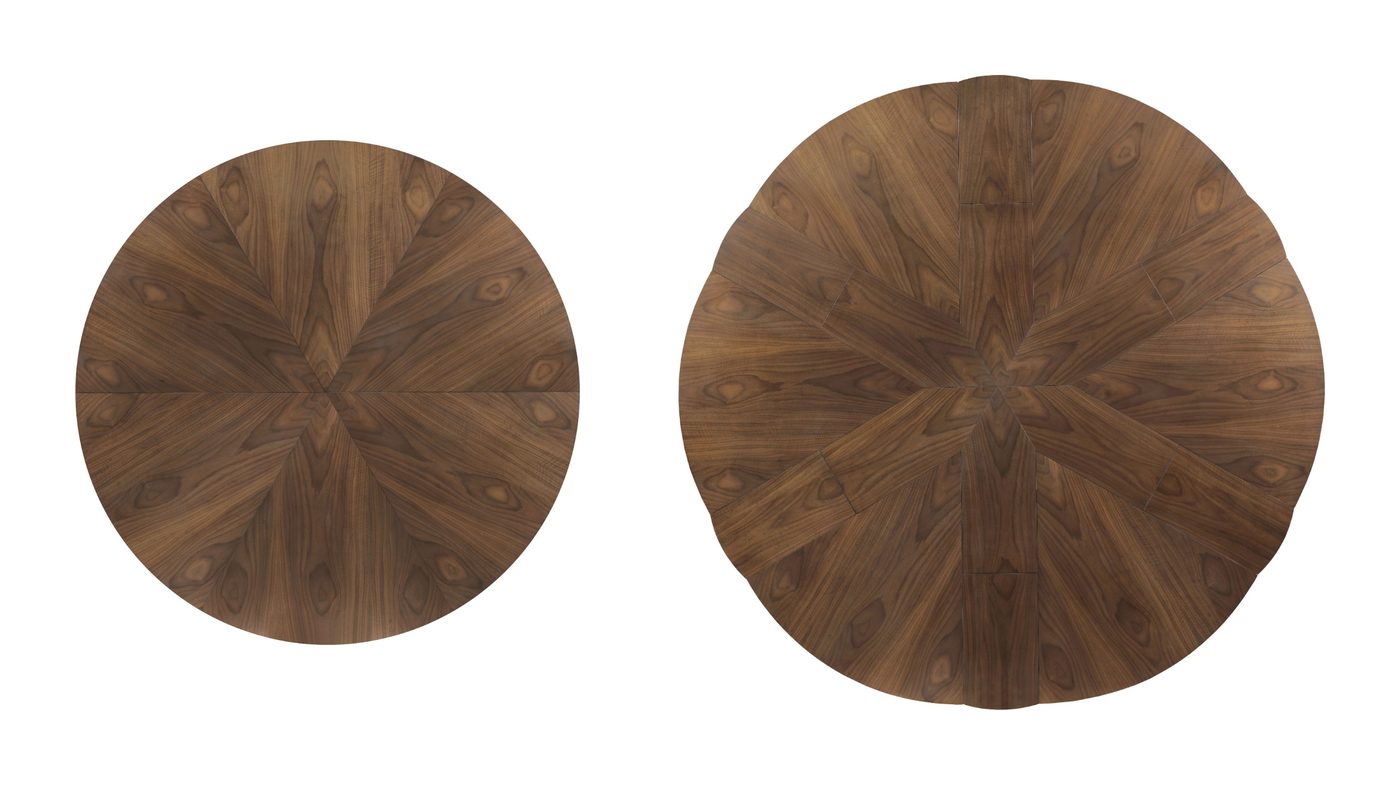
The look is part of the appeal. Closed, a jupe top shows its seams as lines radiating from the center, often set off by veneer laid in matching wedges. Open, the leaves add a second set of rays between the first. Most jupe tables are round, and the same principle now appears on rectangular tables with rounded corners, which grow in both length and width.
How does a jupe table open?
The segments of the top slide straight out from the center, opening a gap between each pair, and a leaf fills every gap until the top is whole again.
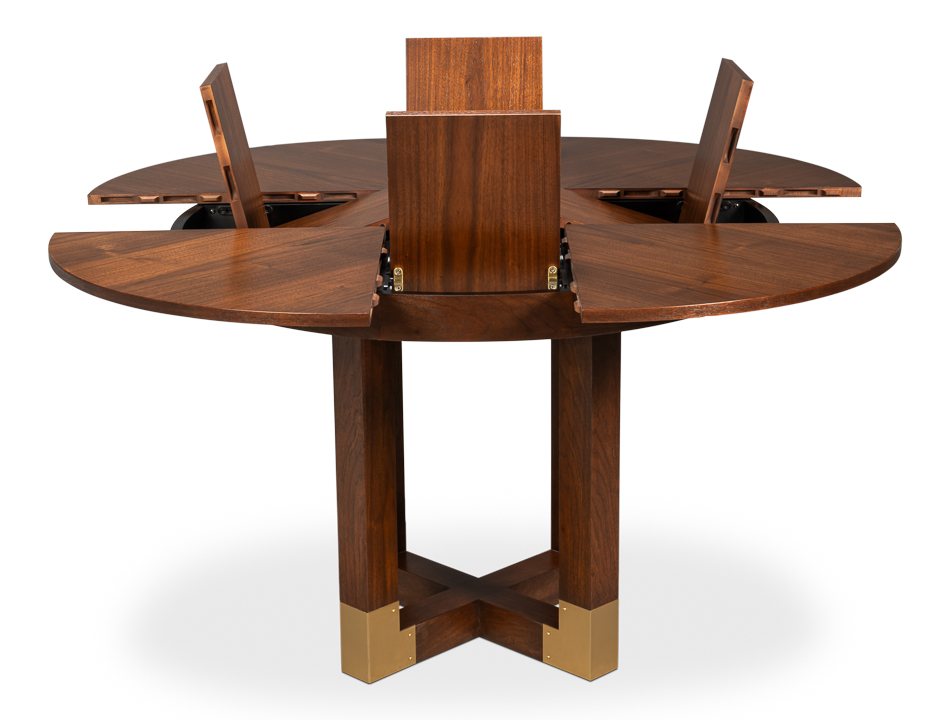
On a modern four-segment table, the four quarters of the top move outward together on a metal frame beneath the top. As they part, a leaf folded under each gap swings up and settles flush into place. Because every quarter moves the same distance, the table grows evenly on all sides and stays centered over its base.
The number of segments varies by design. Antique originals often used eight, and modern tables use four, six, or eight. More segments keep the open table closer to a true circle. Fewer make a simpler mechanism, and the open table reads as a softly rounded square, a little wider corner to corner than across the leaves.
Where did the jupe table come from?
Robert Jupe, an upholsterer working from Welbeck Street in London, patented the expanding round table in 1835, and the firm of Johnstone, Jupe and Company built it in New Bond Street.
Jupe's patent, British patent No. 6788, called it an improved expanding table. On the originals, the host opened the table by turning the top itself. A spiral capstan beneath the top converted that rotation into the outward slide of every segment, and on some surviving tables the brass boss of the mechanism is engraved "JUPES PATENT." The partnership changed within a few years and the firm became Johnstone and Jeanes, which showed a circular expanding table at the Great Exhibition of 1851.
The antique tables also solved the storage question differently. Many came with two sets of leaves in different sizes, so one table could open to two diameters, and the leaves lived in a fitted leaf cabinet of their own. A documented example measures 60 inches closed, 73 inches with its smaller leaves, and 84½ inches with the larger set.
Do modern jupe tables store their own leaves?
Many modern jupes fold their leaves beneath the top, so the table opens with nothing to carry in from another room, while the antique originals kept theirs in a separate cabinet.
Self-storing leaves make a jupe far easier to live with. They are always on hand, they never get lost in a move, and they spend their downtime protected under the top. A separate leaf cabinet has its own charm on an antique, and it allows two sets of leaves, but it is one more piece of furniture to place and one more set of parts to keep track of.
The tradeoff is the space the mechanism takes beneath the top. Sit at a self-storing jupe and check the knee room at more than one chair before you buy, the same test our guide to extendable versus fixed dining tables recommends for any table with a leaf tucked inside.
How many people does a jupe table seat?
Seat a jupe by its open size, using the same math as any round table: a 42-inch jupe seats four closed and six open, and one that opens from 66 to 84½ inches goes from six or eight to about ten.
Common jupe sizes break down like this:
- 42 inches, opening to 56: four guests closed, six open.
- 66 inches, opening to 84½: six to eight closed, about ten open.
- 79 by 43 inches, opening to 100 by 56: eight closed, up to twelve open.
The rectangular jupe is the surprise. A conventional table needs 120 inches or more to seat twelve. A rectangular jupe gets there at 100 inches because it widens as it lengthens, from 43 to 56 inches, which leaves room for two chairs at each end. At about 25 inches of edge per chair, the fit is snug rather than generous, so the full twelve suits a holiday dinner better than a long weeknight one. Our guide to how big a dining table you need has the full seating math for round and rectangular tables.
Is a jupe better than a butterfly leaf or a round-to-oval table?
Choose a jupe when you want a round table to stay round as it grows, and a butterfly leaf or a round-to-oval table when the room is longer than it is wide or a simpler mechanism suits you better.
A jupe has four advantages:
- It keeps its shape. A round jupe opens to a larger round, so everyone can still see everyone, which is the reason to choose a round table in the first place. A round-to-oval table trades that for length.
- It turns its seams into pattern. A center leaf leaves two straight lines across the top. A jupe's seams radiate from the center like the spokes of a wheel, so they read as part of the design.
- It makes an entrance. Opening a jupe in front of guests is a small piece of theater.
- It stays centered. The top grows evenly around its middle, so the base stays centered beneath it, which suits a pedestal or a central column base.
A butterfly leaf stores inside the table too, but it is a single hinged leaf that adds length in one direction. It is a simpler mechanism, and the right answer for a rectangle or an oval that needs to reach a set length. A round-to-oval table splits down the middle and takes a leaf, which suits a dining room that is longer than it is wide.
Room shape often settles the choice. A jupe grows into a square footprint, so it belongs in a square dining room or a generous breakfast room. Allowing 36 inches of clearance on every side, a 56-inch jupe at full size needs at least 128 inches, nearly 11 feet, in both directions.
What should you check before buying a jupe table?
Open and close the table yourself, look closely at every seam, and plan the room around the open size, because the mechanism, the finish, the weight, and the space it needs are where jupe tables differ.
- The mechanism. One person should be able to open the table with steady, even pressure, and every segment should move together. Each leaf should sit flush, with no lip at the seams. The fitting takes real precision, and the showroom is the place to test it.
- The finish. Leaves stored beneath the top see less light than the surface around them, and many woods darken or lighten with light over time. Ask whether the leaves were finished alongside the top, and expect them to need a little time open to match.
- The weight. A jupe carries a mechanism as well as a top. The 42-inch table above is listed at 155 pounds, and the rectangular jupe in the seating drawing at 403 pounds. Plan on white-glove delivery, so the table is set in place and leveled in your room.
- The room. Measure for the open size, not the closed one, and leave room to stand at the table while you open it.
How do you care for a jupe table?
Care for the top like any fine wood surface, open the table now and then so the leaves age with the top, and never force the mechanism.
Leave the table open for a few days every so often, especially in the first year, so the leaves see the same light as the top and age at the same pace. A jupe mechanism relies on close-fitting parts that wear with friction, so open and close it with even pressure, keep crumbs and spills out of the seams, and if it starts to bind, stop and call for service rather than pushing harder. When the table needs to move, lift it rather than dragging it, so the mechanism never takes the strain.
On an antique jupe, keep the leaves in their cabinet inside the house, at the same temperature and humidity as the table, so they never swell or shrink out of fit. For everyday upkeep of the top, see how to care for wood furniture.
Where can I see a jupe table in Kansas City?
A jupe has to be opened in person to be understood, and the Seville Home showroom in Leawood keeps dining tables on the floor, jupe designs among them, to open and sit at.
Bring your room measurements and your largest guest list, and a designer will help you decide whether a jupe, a butterfly leaf, or a round-to-oval table suits the way you host. Visit us at 5205 W 135th Street in Leawood, Monday through Saturday, 10 a.m. to 5 p.m., or explore our dining collection first. Our designers offer complimentary design consultations, in the showroom or in your home, and directions are on our visit page.
Common questions
What is a jupe table?
A jupe table is an expanding dining table, usually round, whose top is divided into segments that slide outward from the center. A leaf fills each gap, so the table grows larger and keeps its round shape. The design is named for Robert Jupe, the London upholsterer who patented it in 1835.
How does a jupe table work?
The top is cut into segments, like slices of a pie, that ride on a frame beneath it. Opening the table slides every segment outward at once, and a leaf fills each gap. On the antique originals, turning the top drove the segments outward and the leaves were kept in a separate cabinet. On modern self-storing designs, the leaves fold beneath the top and swing up into place.
How many people does a jupe table seat?
Seat a jupe by its open size. A 42-inch jupe seats four closed and six when it opens to 56 inches. A jupe that opens from 66 to 84½ inches goes from six or eight guests to about ten. Rectangular jupe tables with rounded corners widen as they lengthen, so one that opens from 79 by 43 to 100 by 56 inches seats eight closed and up to twelve open.
Who invented the jupe table?
Robert Jupe, a London upholsterer, patented the expanding round table in 1835 as British patent No. 6788. The firm of Johnstone, Jupe and Company built the tables in New Bond Street, and its successor, Johnstone and Jeanes, showed a circular expanding table at the Great Exhibition of 1851.
What is the difference between a jupe table and a round-to-oval table?
A round-to-oval table splits down the middle and takes a leaf, so it grows in one direction and becomes an oval. A jupe opens from the center in every direction and stays round. Choose a jupe for a square room, or when you want every guest to see every other guest, and a round-to-oval table for a longer, narrower room.