Are Curved Sofas Practical? Where They Work and Where They Don't
An honest look at curved sofas: how many they seat, whether you can nap on one, where they belong in a room, and how to pair them, from the furniture showroom in Leawood, KS.
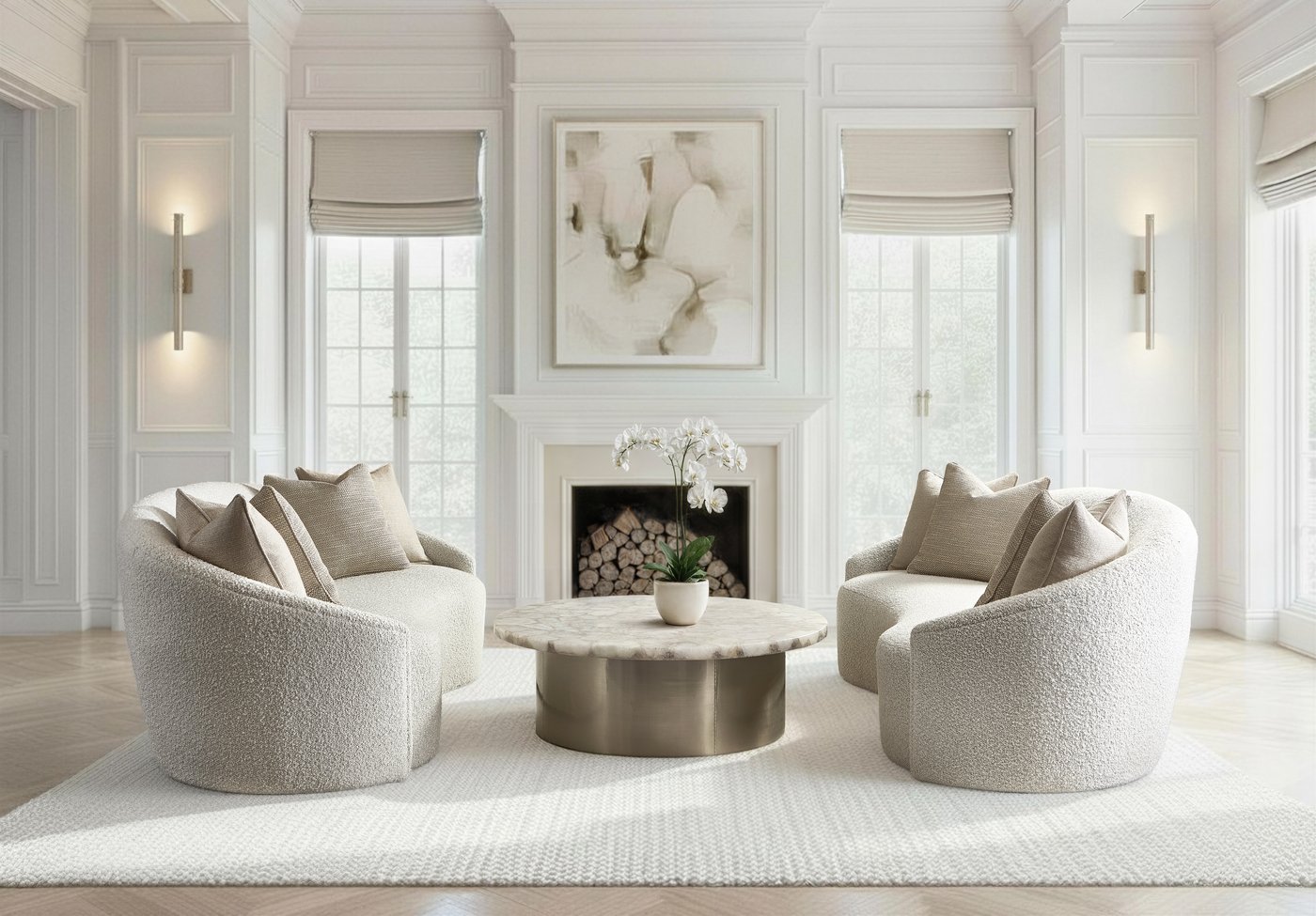
Curved sofas photograph beautifully. In a magazine spread or on a showroom floor, they make every other sofa look stiff. The question people bring to us is whether one will actually work at home, with real guests, a real dog, and a Sunday afternoon when somebody wants a nap.
The honest answer depends on two things, and they are separate questions. The first is how you sit: a curved sofa is built for conversation, not for stretching out. The second is where it goes: a curved sofa is built to float in a room, not to hug a wall. If your room and your habits line up with both, a curved sofa is one of the most practical pieces you can own. If they fight both, a straight sofa will serve you better, and there is no shame in that.
Are curved sofas practical?
Yes, for conversation and in a room with space around it; less so for napping, wall-tight rooms, and squeezing in extra guests.
A curved sofa turns the people sitting on it toward each other. Nobody ends up staring at the side of a neighbor's head, and a group of four or five feels like one conversation instead of two. In a living room meant for company, that is a genuine advantage, not just a look.
The trade-offs are just as real. A curve uses more floor than a straight sofa of the same width, it rarely sits flush to a wall, and it is not built for lying down. Knowing those limits up front is what separates a curved sofa you love from one you tolerate.
How many people does a curved sofa seat?
Fewer than its overall width suggests, so count seats by sitting on it rather than by dividing the length.
On a curved sofa the ends sweep inward, so the people sitting at each end angle toward the middle and their knees drift toward each other. The center seats are generous. The end seats are cozier than the same inches would feel on a straight frame.
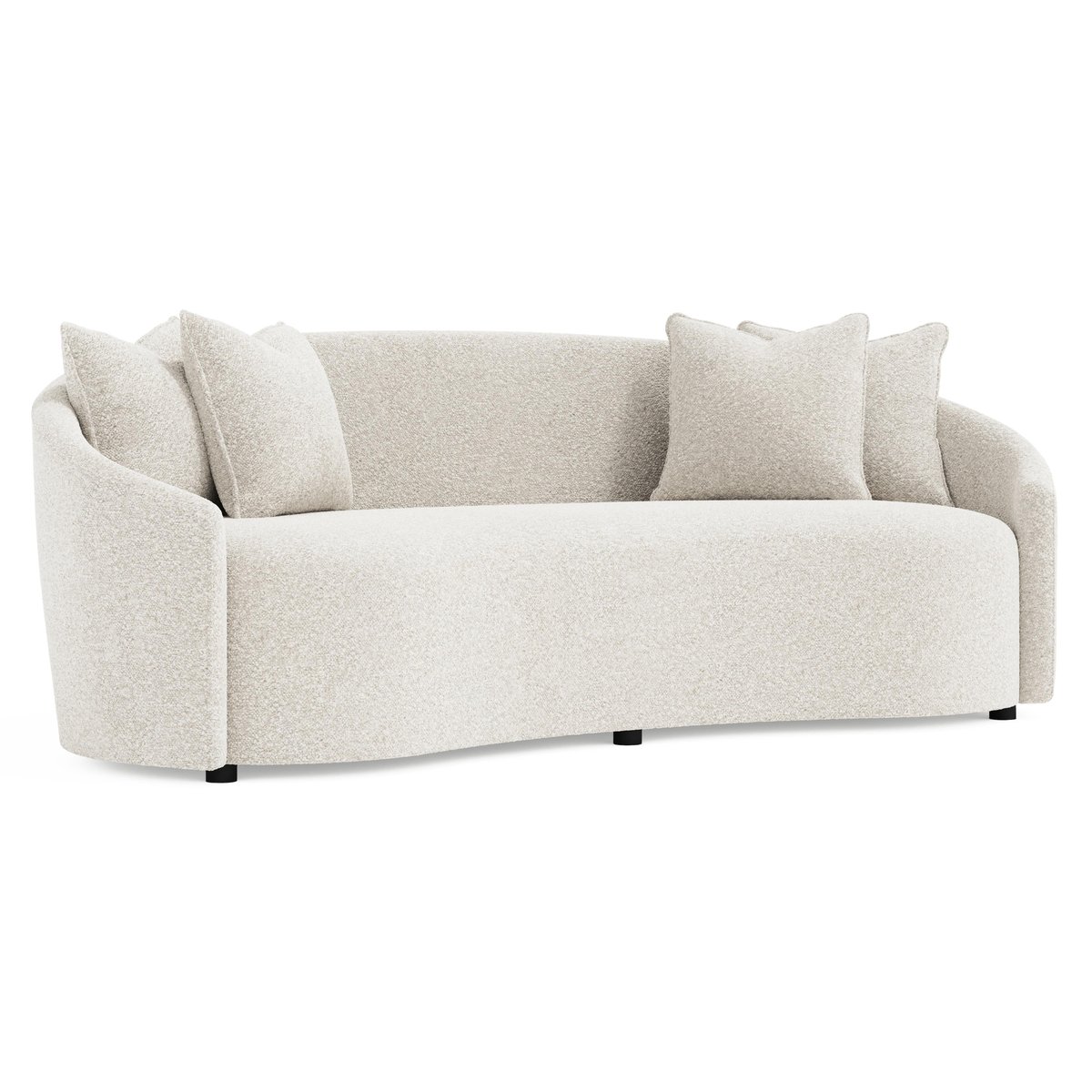
Arm width matters too. The Bernhardt Interiors Lumen sofa, one of two curved sofas on the Seville Home floor, measures 98 inches across but 78 inches between the arms, per Bernhardt's published specifications. Curved sofas often use a single long bench cushion, which seats people flexibly but has no seams to mark where each person goes. Sit on the end seats, not just the middle, before you count on a curved sofa to seat everyone at the holidays.
Can you lie down on a curved sofa?
Not comfortably on most curved sofas, because the curve leaves no straight run to stretch out on and no corner to tuck into.
A straight sofa gives you a long, flat seat and an arm for your head. A curved sofa bends your body along its arc, and a tight back, common on curved frames, gives you no loose cushion to push into shape. Think of a curved sofa as a sofa for conversation more than for movie night.
Seat depth needs a second look, too. Our guide to sofa size and seat depth puts upright sitting at about 20 to 22 inches and lounging at 23 inches or more. Curved sofas often list much deeper numbers: Bernhardt lists 30 inches for the Lumen and 29 for the Ava. On a curve, seat depth changes along the arc, and a listed figure may be taken at the middle, so the ends can feel quite different. Throw pillows bring a deep seat forward for shorter sitters.
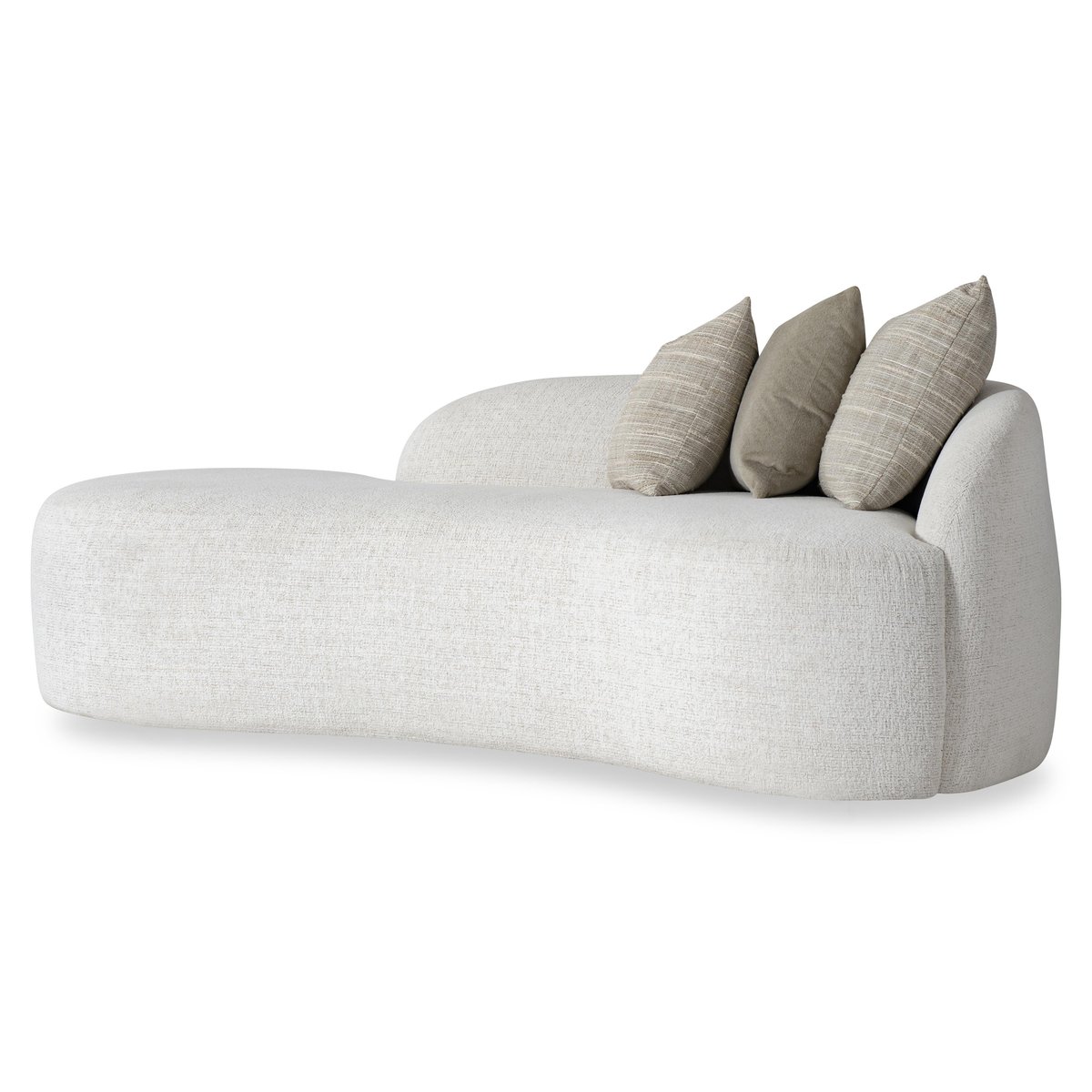
If you love the shape and still want somewhere to put your feet up, look at a one-arm curved sofa. The open end works like a chaise.
Does a curved sofa have to float in the room?
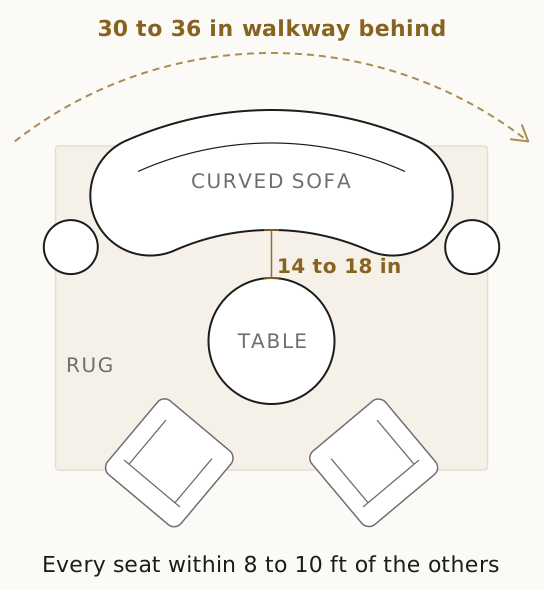
Most look and work best floated, with a 30 to 36 inch walkway behind them, though a gently curved sofa can sit near a wall.
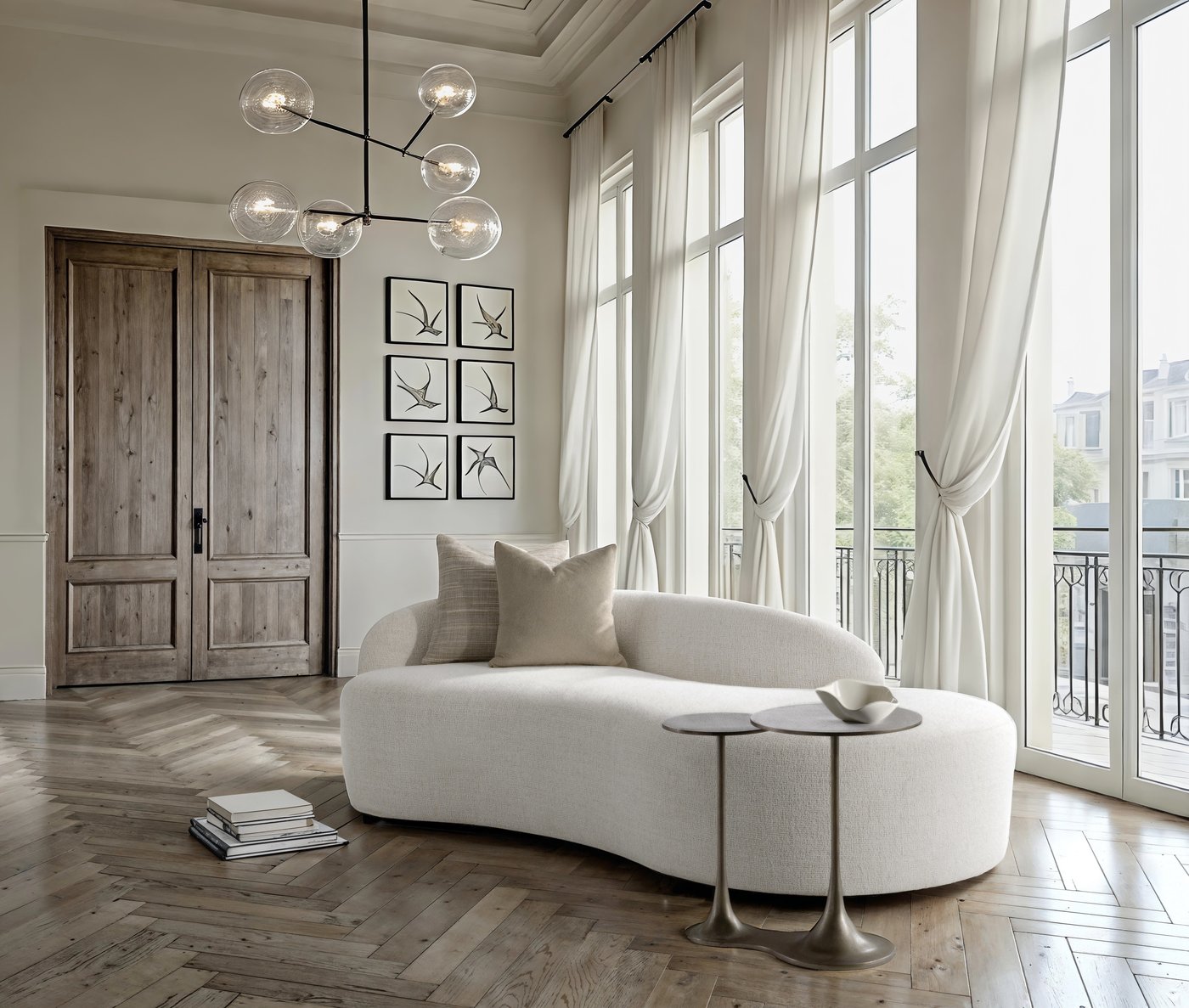
A curved back is shaped and finished to be seen. Push a deep crescent against a flat wall and you hide the best side of the piece while leaving two wedges of dead floor at the ends that nothing fits into. A sofa with only a slight bow can live closer to the wall, which suits a long, narrow room.
Floating is also how the shape earns its keep. Our guide to laying out a living room suggests floating the sofa entirely in rooms wider than about 14 feet, and a curved sofa is the natural candidate. A straight console behind a curve leaves gaps at both ends, so we usually suggest a pair of small round tables or floor lamps beside it instead.
What size room does a curved sofa need?
Plan for more depth than a straight sofa: curved sofas commonly run 42 to 49 inches deep, against 37 to 40 inches for a standard sofa.
The Lumen is 43.5 inches deep, the Ava 42.5, and Vanguard's Bennett curved sofa 49, all per the makers' published dimensions. Add the walkway behind and the 14 to 18 inches in front, and a curved sofa claims a good deal of floor before anyone sits down.
Before ordering, lay the curve out on the floor with painter's tape, bending it to the sofa's depth at the center and the ends. Then check the route in. A curved frame is usually deeper than a straight one, so measure doors, halls, and turns with our guide to measuring for furniture delivery.
Are curved sofas good for entertaining?
Yes, and entertaining is where they shine: the curve points every seat toward the middle of the group.
Hosting is the best reason to buy one. Pair a curved sofa with two chairs across the cocktail table and the group closes into a circle. Set two curved sofas facing each other, as in the photo at the top of this guide, and you have a conversation room that holds six or eight people without anyone shouting. Keep every seat within about 8 to 10 feet of the others, the comfortable talking distance we use in every living room plan.
The same quality makes a curved sofa a weaker television sofa. The arc aims everyone at the center of the room, which is the cocktail table, not the screen. If one room has to do both jobs, give the television to a straight sofa or sectional and let the curved piece anchor a second seating group.
What table, rug, and lighting go with a curved sofa?
A round or oval cocktail table, a rug that catches every front leg, and light that does not depend on a wall outlet.
A round or oval table echoes the curve and keeps every seat an equal reach away. Measure the 14 to 18 inch gap at the center of the curve, since the ends sweep closer.
For the rug, follow the same rule as any seating group: the front legs of the sofa and every chair belong on it. A floated curved sofa with chairs opposite usually wants a 9 by 12; our rug size guide has the room-by-room numbers.
Lighting is the detail people miss. A floated sofa sits far from the wall outlets, so plan floor lamps at the ends with cords run under the rug, or ask an electrician about a floor outlet. Small round or pedestal side tables tuck neatly against curved arms where a square table would leave an awkward gap.
Are curved sofas a fad?
No: the curved sofa dates to at least 1950, though today's wave of interest is unusually strong.
Vladimir Kagan designed his Serpentine sofa in 1950 because, in his view, the rigid sofa did not suit the way people actually entertained; moving seating off the walls helped conversation and freed the walls for art. The design is still in production. What comes and goes is the exaggerated version: the tightest crescents and the loudest fabrics.
As we wrote in design trends that last, subtle curves are timeless. A gentle arc, a well-built frame, and a fabric you would choose for any sofa will outlive the trend cycle. If you are unsure, consider a curved sofa as the second sofa in a room rather than the only one.
Where can I sit on a curved sofa in Kansas City?
At Seville Home in Leawood, where two curved sofas are on the floor and many more can be ordered in the fabric you choose.
The Bernhardt Lumen, in ivory bouclé, and the Bernhardt Ava, a one-arm curved sofa, are on the floor now. Sit on the ends of any curved sofa as well as the middle, and try a pillow behind your back to feel the seat depth change along the curve.
If neither is the one, curved frames are available to order from lines Seville Home carries, including Bernhardt, Century's Cornerstone configurable curved sofa, and Vanguard's Bennett curved sofa, in fabrics from our library through the custom upholstery program. Browse our sofas and sectionals to compare shapes.
Bring your room measurements to 5205 W 135th Street in Leawood, Monday through Saturday, 10 a.m. to 5 p.m. Plan your visit or book a complimentary design consultation, and we will help you decide whether a curved sofa belongs in your room, and which one.
Common questions
Are curved sofas practical?
Yes, in the right room and for the right job. A curved sofa is one of the best pieces you can buy for conversation and entertaining, and it works best floated with space around it. It is less practical for napping, for rooms where it must sit tight against a wall, and for households that count on squeezing in one more person, because the curved ends seat fewer people than the overall width suggests.
Can you lie down on a curved sofa?
Not comfortably on most. The curve leaves no straight run to stretch out on, and many curved sofas have tight backs and no corner to tuck into. If napping matters, look at a one-arm curved sofa with an open end, keep a straight sofa or sectional in the family room, or put the curved sofa in the room where people talk rather than watch.
Can a curved sofa go against a wall?
A gently curved sofa can sit near a wall, but a pronounced curve leaves awkward wedges of empty floor at each end and hides the shaped back it was designed to show. Most curved sofas look and work best floated, with a 30 to 36 inch walkway behind them.
What coffee table goes with a curved sofa?
A round or oval cocktail table echoes the curve and keeps every seat an equal reach from the table. Leave 14 to 18 inches between the front of the sofa and the table, measured at the center of the curve, and size the rug so the front legs of the sofa and every chair sit on it.
Are curved sofas a fad?
The shape is not new. Vladimir Kagan designed his curved Serpentine sofa in 1950 to bring guests together away from the walls, and it is still in production. Today's interest is strong, but a well-made curved sofa in a fabric you love is a long-term piece, especially with a gentle curve and a quiet color.